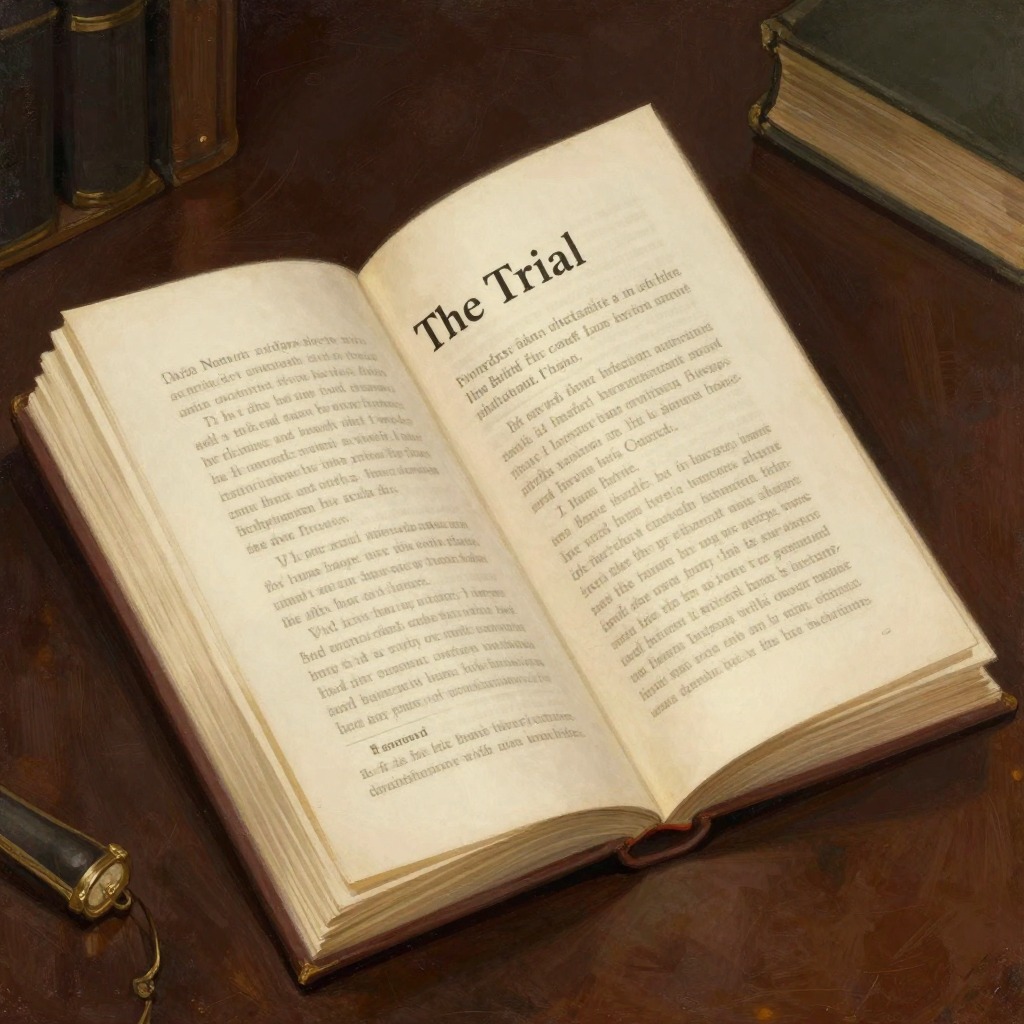
Like a dog!
The expression "Like a dog!" is Josef K.'s final utterance in Franz Kafka's The Trial, spoken as he is executed in a quarry on the eve of his thirty-first birthday. It crystallizes the shame and degradation that outlive him, transforming the entire novel's legal and existential struggle into a single, damning verdict on how he has been treated and how he has died.
Context and Utterance
On the evening before his thirty-first birthday, two men in frock coats and top hats arrive at K.'s lodging house and take him through the streets to an abandoned quarry on the outskirts of the city. There, after a series of awkward formalities, one of the men draws a long, thin, double-edged butcher's knife from a sheath on his belt. The men pass the knife back and forth over K., expecting him to take it and thrust it into himself. K. does not do so. Instead, he twists his neck and looks around, seeing a light flicker on in a top-floor window of a nearby building; a figure leans out, stretching out its arms. K. wonders who it might be — a friend, a good person, someone who wants to help — and asks himself whether there are objections that have been forgotten. He raises both hands and spreads out all his fingers. But then one of the men lays his hands on K.'s throat while the other pushes the knife deep into his heart and twists it twice. As his eyesight fails, K. sees the two men cheek by cheek, close in front of his face, watching the result. "Like a dog!" he says, and the narrative adds: "it was as if the shame of it should outlive him."
Thematic Significance
The phrase "Like a dog!" serves as K.'s final, self-conscious judgment on the manner of his death. Throughout the novel, K. has insisted on his innocence and has sought to defend himself against an opaque and seemingly arbitrary court. He has been arrested, interrogated, and subjected to a trial whose logic he cannot grasp. The court, as the prison chaplain tells him in the cathedral, "doesn't want anything from you. It accepts you when you come and it lets you go when you leave." K.'s death is not a punishment for a proven crime but an execution that follows from the mere fact of the proceedings. The shame that "should outlive him" is not the shame of guilt but the shame of being treated as something less than human — of being killed "like a dog" rather than as a man who has faced his accusers and received a verdict. The expression thus becomes the novel's final, irreducible statement on the nature of the court and the fate of those it ensnares.
Narrative Role and Evaluation
"Like a dog!" is the last line of dialogue in the novel and the only words K. speaks during the execution scene. It is a performative utterance in the sense that it does not describe a state of affairs but enacts a final act of self-definition. K. does not cry out for help, curse his executioners, or proclaim his innocence; he names the manner of his death and, in doing so, asserts that it is shameful. The phrase also echoes earlier moments in the novel. When K. is first arrested, the policeman Willem tells him that the court is "attracted by the guilt, like it says in the law." The animal imagery recurs when K., in the court offices, feels as if he is suffering sea-sickness and is led out by the information-giver and the young woman. The execution itself, with the two men forming "a unit of the sort that normally can be formed only by matter that is lifeless," reduces K. to a passive object. "Like a dog!" is the final, bitter recognition of this reduction — a verdict that K. passes on himself and on the system that has destroyed him.